
Introduction to Safar Ki Dua
Embarking on a journey, whether for business, Hajj, Umrah, or visiting family, is laden with both excitement and potential hardship. Islam provides spiritual tools to navigate these travels with ease and divine protection. One such tool is the prophetic supplication known as Safar Ki Dua. This dua not only seeks Allah’s protection from the physical perils of travel but also invites His blessings in every step of the journey, transforming mundane movement into an act of worship.
Quranic Basis for Travel in Islam
Travel (safar) holds a sanctified position in the Islamic worldview. The Quran emphasizes both the purpose and etiquette of travel, encouraging believers to reflect on Divine creation:
so that you may sit firmly on their backs, and remember your Lord’s blessings once you are settled on them, saying, “Glory be to the One Who has subjected these for us, for we could have never done so ˹on our own˺.
And surely to our Lord we will ˹all˺ return.”
Reference – Qur’an 43:13-14
These verses underscore two core lessons:
- The Earth is a vast expanse ready for human exploration.
- Travel provides sustenance—both physical provision and spiritual insight.
Arabic Text, Transliteration & Meanings
Arabic Text:
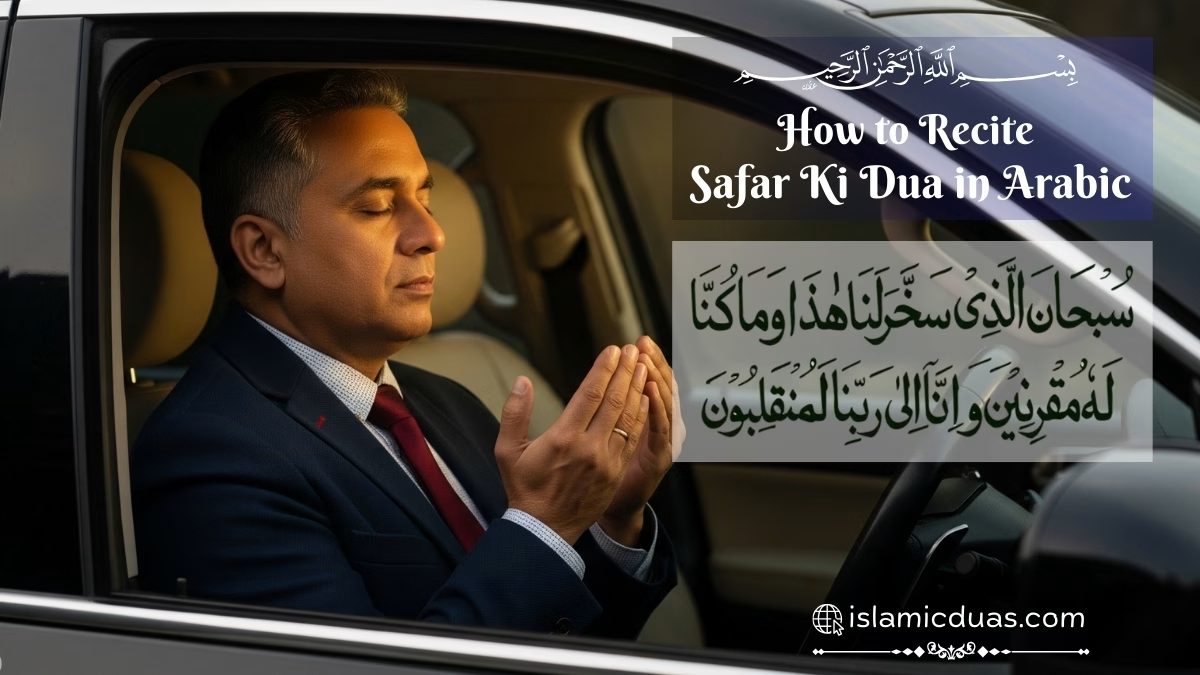
سُبْحَانَ الَّذِي سَخَّرَ لَنَا هَذَا وَمَا كُنَّا لَهُ مُقْرِنِينَ وَإِنَّا إِلَى رَبِّنَا لَمُنْقَلِبُونَ
Transliteration:
Subḥāna allathee sakhkhara lanā hādhā wamā kunnā lahu muqrīnīna, wa-innā ilā rabbina lamunqalibūna.
English Translation:
“Glory be to Him Who has subjected this to us, and we could never have it by our efforts. And surely to our Lord we shall return.”
Hindi Translation:
“तारीफ़ उसी के लिए है जिसने इसको हमारे लिए आसान किया, जबकि हम इसकी काबिल नहीं थे। और निश्चित ही हम अपने रब की तरफ लौटेंगे।”
Authentic Hadith on Safar Ki Dua
The Prophet Muhammad ﷺ taught this dua when embarking on a journey:
“If any one of you intends to set out on a journey, let him say:
‘Allāhumma inni a‘ūdhu bika min wa‘thā’i s-safar, wa ka‘abatil-manzari, wa su’il-munqalabi.’”
— Sahih Muslim, 1342
Explanation:
- Min wa‘thā’i s-safar: Protection from the hardships of travel.
- Ka‘abatil-manzari: Protection from unpleasant sights.
- Su’il-munqalabi: Protection from an evil outcome or bad ending.
Spiritual Benefits and Virtues
- Divine Protection: Shields travelers from accidents, illness, and unseen dangers.
- Barakah in Provision: Invokes Allah’s blessing in sustenance—food, fuel, accommodations.
- Inner Tranquility: Eases anxiety, transforming travel into a source of spiritual calm.
- Remembrance of Return: Reminds the believer of eventual return to Allah, fostering humility.
- Act of Worship: Traveling with this dua becomes a form of dhikr, turning mundane movement into worship.
Etiquettes & Sunnahs of Travel
Islamic travel etiquette encompasses practical actions and spiritual practices:
- Make Intention (Niyyah): Begin with a pure intention, seeking Allah’s pleasure.
- Purification: Perform wudū (ablution) if possible before departure.
- Dua Upon Mounting: Recite Safar Ki Dua when boarding any conveyance—car, plane, ship, or camel.
- Dhikr During Travel: Engage in continuous dhikr (Subḥānallāh, Al-ḥamdu lillāh, Allāhu akbar).
- Shortening Prayers: If travel distance exceeds fiqh threshold, shorten four-unit prayers to two (qasr) [Sahih Bukhari].
- Maintain Good Conduct: Uphold Islamic manners—help fellow travelers, avoid disputes, and guard speech.
Scholarly Insights Across Sunni Schools
All four major Sunni madhhabs recognize and encourage this dua, with slight variations:
| School | Variation | Commentary |
| Hanafi | Adds emphasis on initial dhikr | Encourages reciting Subḥānā in multiples. |
| Shafi‘i | Adds praise clause (“Al-ḥamdu lillāh”) | Valid if recited anytime before departure. |
| Maliki | Shortened form focusing on hardship | Emphasizes seeking refuge from travel woes. |
| Hanbali | Full narration as in Sahih Muslim | Repetition enhances spiritual safeguard. |
Types of Travel Duas
Beyond Safar Ki Dua, Islam prescribes duas for specific travel moments:
- Dua for Departure: Seeking ease in beginning the journey.
- Dua for Arrival: Thanking Allah upon reaching the destination.
- Dua in Flight/Seamless Transit: Specific prayers for air travel.
- Dua for Mounting: Recited when boarding any mode of transport (animal, vehicle).
Dua for Arrival (Wusool)
“Al-ḥamdu lillāh allathee bi faḍlihi tasarrafnā.”
“Praise be to Allah by whose grace we have reached our destination.”
Modern Applications and Contexts
- Air Travel: Recite Safar Ki Dua before takeoff; dua for arrival upon landing.
- Long Road Trips: Pause at rest stops for dhikr and short duas.
- Sea Voyages: Use the dua while boarding and again when disembarking.
- Business and Pilgrimage: Apply the same supplication, reinforcing spiritual focus.
Practical Tips for Memorization and Recitation
- Use Audio Resources: Listen to recordings in Arabic and transliteration.
- Flashcards: Create flashcards with Arabic on one side and meanings on the other.
- Daily Practice: Integrate recitation during daily dhikr sessions.
- Family Engagement: Teach children and travel companions the dua.
Frequently Asked Questions (PAA Optimized)
- What is the full text of Safar Ki Dua?
The dua consists of praising Allah, seeking refuge from travel hardship, unpleasant sights, and bad endings as taught by the Prophet ﷺ. - How do I recite Safar Ki Dua in Urdu/Hindi?
Use transliterations like “Allāhumma inni a‘ūdhu bika min wa‘thā’i s-safar…” followed by translation in Urdu/Hindi for understanding. - Can I make Safar Ki Dua in my heart without vocalizing?
Yes, mental supplication is valid if one cannot speak aloud due to circumstances. - Are there any Hadith about Dua upon reaching a destination?
Yes. Upon arrival, one says: “Al-ḥamdu lillāh allathee bi faḍlihi tasarrafnā.” - Does Safar Ki Dua apply if traveling within city limits?
It applies when the journey meets the fiqh distance of safar, though reciting it always brings barakah.
Conclusion & Call to Action
Reciting Safar Ki Dua roots your journey in divine remembrance, securing Allah’s protection and blessings along the way. Whether traveling for pilgrimage, business, or leisure, this timeless supplication transforms each step into an act of worship.
Embrace this sunnah: memorize the dua, share it with loved ones, and visit the Islamic Dua Knowledge Hub for more authentic supplications.
Author Profile

-
Nadiya Khan is a graduate in Islamic Studies and an experienced writer with over 12 years dedicated to Islamic content writing. She specializes in sharing authentic duas and teachings from the Qur’an and Sunnah, drawing on trusted sources accepted across the four Sunni madhhabs Hanafi, Shafi’i, Maliki, and Hanbali.
Her work focuses on making Islamic knowledge clear, practical, and spiritually uplifting for Muslims seeking guidance, protection, and peace in daily life. Through the Islamic Dua Knowledge Centre, she helps readers strengthen their bond with Allah ﷻ by presenting duas with accuracy, context, and heartfelt reflection.
Nadiya’s mission is simple: to revive the practice of dua as a source of comfort, gratitude, and closeness to the Creator.
Latest Islamic Post
 Hajj and UmrahApril 13, 2026Powerful Tawaf Duas for All 7 Rounds (Authentic & Heart-Touching Guide)
 Important Duas for Daily LifeApril 6, 2026Wazu Ke Baad Ki Dua | Sunnah Dua & Benefits Guide
 Islamic TravelAugust 24, 2025Haramain Train Guide | Fast Mecca-Medina Travel
 Important Duas for Daily LifeAugust 24, 2025Dua for Journey | Essential Protection for Road & Flight Travel
Related Islamic posts:
Dua for Journey | Essential Protection for Road & Flight Travel
 Humbistari ki Dua: Islamic Dua for Marriage Intimacy and Protection
 Nazar Ki Dua in English | Authentic Islamic Evil Eye Protection
Bukhar Ki Dua Guide | Prophetic Supplications for Fever Relief
Doodh Peene Ki Dua | Sunnah, Benefits & Etiquettes in Islam
 Iftar Ki Dua | Authentic Supplication with Meaning & Transliteration
