
Iftar Ki Dua – Complete Guide in Arabic, English, Hindi, Urdu & Bangla
Importance of Iftar Dua in Islam
In Islam, fasting (sawm) during the month of Ramadan is one of the Five Pillars of faith. Muslims abstain from food, drink, and other physical needs from dawn (suhoor) until sunset (iftar). The moment of iftar is one of relief, gratitude, and immense spiritual blessings.
The Prophet Muhammad ﷺ taught us that dua (supplication) made at the time of breaking the fast is never rejected. This makes the moment of iftar one of the most powerful times for Muslims to seek forgiveness, blessings, and mercy from Allah.
Hadith Reference:
“When the fasting person breaks his fast, his supplication is not turned back.”
Reference : Sunan Ibn Majah 1753
Reciting the Iftar ki Dua is therefore an essential Sunnah practice that connects the believer to Allah while breaking the fast.
Iftar Ki Dua in Arabic (Original Sunnah Supplication)
The authentic dua for iftar, as narrated from the Prophet ﷺ, is:
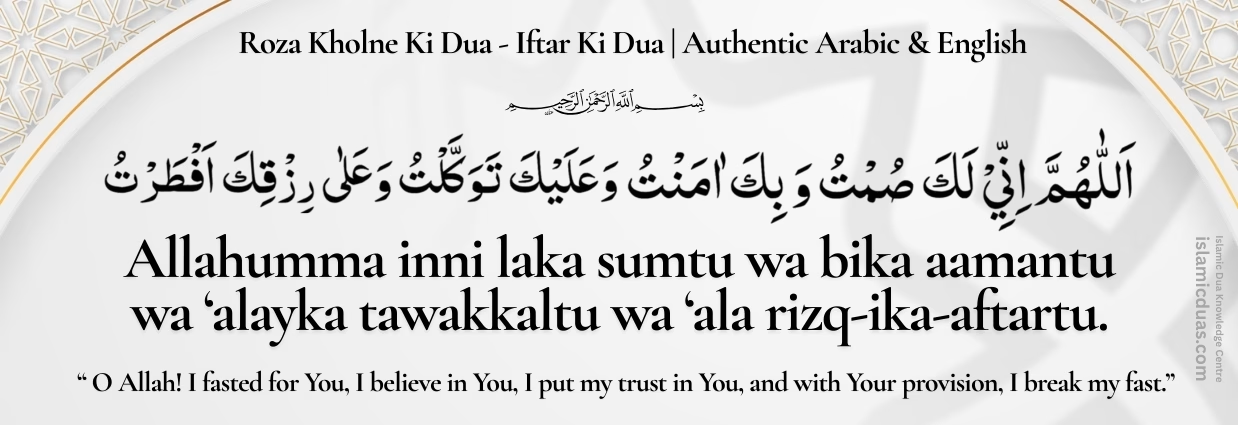
اللَّهُمَّ إِنِّي لَكَ صُمْتُ وَبِكَ آمَنْتُ وَعَلَيْكَ تَوَكَّلْتُ وَعَلَى رِزْقِكَ أَفْطَرْتُ
Transliteration:
Allahumma inni laka sumtu wa bika aamantu wa ‘alayka tawakkaltu wa ‘ala rizq-ika-aftartu
English Translation:
“O Allah! I fasted for You, I believe in You, I put my trust in You, and with Your provision, I break my fast.”
There is another short and commonly accepted Iftar dua also narrated, often quoted as:
ذَهَبَ الظَّمَأُ وَابْتَلَّتِ الْعُرُوقُ وَثَبَتَ الأَجْرُ إِنْ شَاءَ اللَّهُ
English Translation:
Thirst has gone, the arteries are moist, and the reward is sure, if Allah wills.
Reference : Sunan Abi Dawud 2357
Word-by-Word Meaning
- Allahumma inni – O Allah, indeed I
- laka sumtu – fasted for You
- wa bika aamantu – and I believed in You
- wa ‘alayka tawakkaltu – and I relied upon You
- wa ‘ala rizq-ika-aftartu – and with Your sustenance, I break my fast
This dua expresses gratitude, faith, and reliance upon Allah at the most sacred moment of the day.
Iftar Ki Dua in English
For those who do not read Arabic fluently, the iftar dua can also be recited in English translation to remember the meaning:
Translation:
“O Allah! I fasted for You, I believe in You, I put my trust in You, and with Your provision, I break my fast.”
Why recite in English?
- Helps non-Arabic speakers understand the spirit of the dua
- Encourages children and new Muslims to connect with the meaning
- Builds spiritual consciousness beyond just words
However, it is recommended to memorize the Arabic version gradually, since that is the original Sunnah of the Prophet ﷺ.
Iftar Ki Dua in Hindi
Many Muslims in India search for iftar ki dua in Hindi. Here is the dua written in Devanagari script:
अल्लाहुम्मा इन्नी लका सुम्तु व बिका आमन्तु व अलैका तवक्कल्तु व अला रिज़किका अफ़्तर्तु
This transliteration helps Hindi-speaking Muslims to recite the dua correctly.
Iftar Ki Dua in Urdu
For Urdu-speaking Muslims, the dua is often written as:
اَللّٰهُمَّ اِنِّي لَكَ صُمْتُ وَبِكَ اٰمَنْتُ وَعَلَيْكَ تَوَكَّلْتُ وَعَلٰى رِزْقِكَ اَفْطَرْتُ
Benefits of Urdu Dua
- Urdu is widely spoken across Pakistan and India
- Urdu translations make the dua easier for learners
- Helps children and elders memorize quickly
Iftar Ki Dua in Bangla
In Bangladesh, many Muslims recite the dua in Bangla transliteration:
আল্লাহুম্মা ইন্নি লাকা সুম্তু ওয়া বিকা আমান্তু ওয়া আলাইকা তাওয়াক্কাল্তু ওয়া আলা রিজকিকা আফতার্তু
Bangla translations allow new generations to better understand and connect with the supplication while preserving the Sunnah.
Variations of Iftar Dua People Search For
People often use different terms when looking for the iftar dua:
- Roza Iftar ki Dua – Refers to the general dua for breaking the fast.
- Iftar Kholne ki Dua – Common phrase meaning dua to open the fast.
- Iftar Karne ki Dua – Another phrase for the same dua.
- Iftar ke Waqt ki Dua – Supplication specifically at the time of iftar.
- Iftar se Pehle ki Dua – Some Muslims recite a short Bismillah before breaking fast.
- Iftar ke Baad ki Dua – Duas of gratitude and additional prayers after iftar.
Though phrased differently, they all point back to the same authentic dua of the Prophet ﷺ.
Benefits of Reciting Iftar Ki Dua
- Acceptance of Prayers – The Prophet ﷺ said that dua made at iftar is not rejected.
- Gratitude – Acknowledges Allah as the Provider of sustenance.
- Strengthened Faith – Declares belief and reliance upon Allah.
- Sunnah Practice – Fulfills the way of the Prophet ﷺ.
- Spiritual Blessing – Increases mindfulness of Allah at a moment of relief.
Step-by-Step Guide – How to Recite Iftar Dua Correctly
- Step 1: Make intention (niyyah) for fasting before dawn.
- Step 2: Wait for the Maghrib Adhan (sunset prayer call).
- Step 3: Prepare dates and water, as per Sunnah.
- Step 4: Recite the dua sincerely in Arabic or with understanding.
- Step 5: Break the fast with dates and water.
- Step 6: Offer Maghrib prayer immediately after.
This step-by-step approach ensures both physical and spiritual benefit.
Frequently Asked Questions (FAQ)
Q1: Can I recite Iftar ki Dua in English instead of Arabic?
Yes, you may recite in English for understanding, but learning the Arabic version is recommended.
Q2: What if I forget the dua at iftar?
You can simply say “Bismillah” and break your fast.
Q3: Is there a separate dua for suhoor and iftar?
Yes, there are duas for both. Suhoor has its own supplications.
Q4: Is Iftar Dua mandatory?
It is Sunnah, not fard. However, reciting it is highly recommended.
Q5: Can I teach children the dua in Hindi/Urdu?
Yes, transliterations in local languages help children memorize easily.
Q6: Does dua after iftar also get accepted?
Yes, dua at the time of breaking fast and after Maghrib is highly accepted.
Conclusion – Power of Dua at Iftar
The Iftar ki Dua is more than just words – it is a declaration of faith, gratitude, and trust in Allah. Whether recited in Arabic, English, Hindi, Urdu, or Bangla, its purpose remains the same: to glorify Allah at the blessed moment of breaking the fast.
Muslims are encouraged to memorize and teach this dua to their families, ensuring the Sunnah is preserved across generations.
Author Profile

- Mohammed Aman Khan is a student of Islamic knowledge who writes about authentic duas and supplications from the Qur’an Majeed and Sunnah. His aim is to make Islamic teachings simple and accessible for Muslims around the world. With a deep respect for Sunni scholarship, he shares duas that help believers strengthen their faith, find peace in hardship, and grow closer to Allah through sincere remembrance.
Latest Islamic Post
 Hajj and UmrahSeptember 23, 2025What are the Perks of Choosing an Umrah Package?
 Important Duas for Daily LifeAugust 25, 2025Do Sajdon Ke Darmiyan Ki Dua | Authentic Hadith, Text & Meaning
 Important Duas for Daily LifeAugust 23, 2025Humbistari ki Dua: Islamic Dua for Marriage Intimacy and Protection
 Important Duas for Daily LifeAugust 22, 2025Dua for Parents | Quranic Supplications & Benefits
Related Islamic posts:
 Islamic Duas for the Deceased From the Quran and Sunnah
 Barkat Ki Dua | Authentic Islamic Supplications for Abundance
Istighfar Dua Guide | Seeking Forgiveness in Islam
Washroom Ki Dua | Full Guide with Etiquette & Mistakes
Doodh Peene Ki Dua | Sunnah, Benefits & Etiquettes in Islam
Good Morning Dua in Urdu | Start Your Day with Barakah
